

In textile sourcing, quality is not a single checkpoint — it is a continuous process that spans every stage of production from raw material selection to final packaging. For apparel brands that stake their reputation on the fabrics they use, the quality assurance practices of their textile supplier are as important as the fabric itself. A beautiful bouclé that varies in weight by 15% between rolls creates cutting and sewing problems at the garment factory. A wool-polyester blend with inconsistent color fastness generates customer complaints and returns. These are not theoretical risks — they are daily realities in textile manufacturing, and they are the reason that serious buyers evaluate a supplier's quality control infrastructure before placing production orders.
The Quality Philosophy: Prevention Over Detection
The foundation of Jiangyin Shanglin Textile wool quality inspection is a prevention-oriented philosophy rather than a detection-oriented one. Many textile factories rely primarily on end-of-line inspection — examining finished fabric for defects after production is complete. While this catches obvious problems, it is inherently wasteful: defective fabric has already consumed yarn, machine time, energy, and labor before being identified and rejected.
Shanglin's approach embeds quality control at every production stage, catching potential issues before they propagate into finished fabric. This philosophy requires more skilled labor, more frequent testing, and more sophisticated process monitoring — but it produces better results at lower total cost because it prevents waste rather than merely identifying it.
The prevention philosophy manifests in five quality control stages, each targeting specific risk factors in the production process.
Stage 1: Raw Material Quality Verification
The quality of finished fabric is fundamentally constrained by the quality of raw yarn. Shanglin Textile premium knit fabric testing begins before knitting starts — with incoming yarn inspection that verifies fiber composition, yarn count, twist level, color consistency, and freedom from contaminants.
For natural fibers like wool, alpaca, and mohair, incoming inspection includes visual examination for foreign matter (vegetable matter, synthetic fiber contamination), measurement of fiber diameter (finer fibers produce softer fabrics), and assessment of fiber length distribution (shorter fibers create weaker yarns and more pilling potential). For synthetic fibers like polyester and nylon, inspection focuses on denier consistency, elongation properties, and dye lot uniformity.
Yarn count verification — confirming that the yarn thickness matches the specification — is performed using standardized wrapping methods. A yarn that is thicker or thinner than specified will produce fabric with incorrect GSM and different hand feel, even if all other parameters are correct. Shanglin maintains a library of approved yarn specifications from each supplier, and any incoming yarn that falls outside tolerance ranges is rejected before entering production.
Color consistency is verified by comparing incoming yarn against approved standard swatches under standardized lighting conditions (D65 daylight simulation). Even slight color variations between yarn lots can create visible shade differences in finished fabric, so Shanglin segregates yarn by lot number and ensures that each production run uses yarn from a single, consistent lot.
Stage 2: In-Process Knitting Quality Monitoring
During the knitting process, Shanglin Textile fabric quality control standards require continuous monitoring by machine operators and periodic sampling by quality supervisors. This dual-layer approach catches both immediate defects (dropped stitches, yarn breaks, pattern errors) and gradual deviations (tension drift, GSM variation, width inconsistency) that develop over time.
Operator visual inspection. Each knitting machine operator performs continuous visual monitoring of the fabric as it emerges from the machine. Operators are trained to detect dropped stitches (which appear as small holes or runs in the fabric), yarn breaks (which create visible lines or gaps), tension irregularities (which manifest as uneven fabric density), and pattern deviations (particularly in jacquard fabrics where complex motifs require precise needle control). When an operator detects a defect, production is stopped immediately, the issue is corrected, and the affected fabric section is marked for segregation.
Stage 3: Finishing Process Quality Control
The finishing stage — where raw knitted fabric is washed, heat-set, brushed, and treated — introduces its own quality variables that require dedicated control measures. Shanglin Textile premium knit fabric testing during finishing focuses on dimensional stability, color fastness, surface quality, and hand feel consistency.
Dimensional stability verification. After heat setting, fabric samples are measured for width, GSM, and shrinkage potential. The fabric is washed according to standardized test methods (typically 3 cycles at 40°C) and re-measured to determine residual shrinkage. For most apparel applications, acceptable shrinkage is 3-5% in both warp and weft directions. Fabric that exceeds these limits requires additional heat setting or process adjustment before being approved for shipment.
Color fastness testing. Finished fabric samples are tested for color fastness to washing, light exposure, and rubbing (crocking). These tests use standardized methods — typically ISO or AATCC test protocols — and results are rated on a 1-5 scale where 5 represents no color change or transfer. Shanglin's quality standards typically require minimum ratings of 4 for washing fastness and 3-4 for light and rubbing fastness, though specific requirements vary by client and application.
Stage 4: Final Inspection and Grading
The Shanglin Textile fabric quality control standards culminate in a comprehensive final inspection that every meter of fabric undergoes before packaging. This inspection uses the internationally recognized 4-point system (or similar defect scoring methods) to quantify fabric quality and determine whether each roll meets the client's acceptance criteria.
The 4-point inspection system. Each defect found during final inspection is assigned a point value based on its severity and size: major defects (holes, stains, color variations) receive 4 points; moderate defects (minor pattern errors, slight GSM variation) receive 2-3 points; minor defects (small slubs, slight tension marks) receive 1 point. The total points per 100 square yards are calculated, and fabric that exceeds the acceptable point threshold is downgraded or rejected.
Illuminated inspection tables. Final inspection is performed on backlit inspection tables that allow inspectors to see through the fabric and detect defects that may not be visible under normal lighting. The fabric passes over the illuminated surface at controlled speed (typically 15-25 meters per minute), allowing inspectors to examine both sides of the fabric systematically.
Defect mapping. For each roll, the location and type of every defect is recorded on a roll map that accompanies the fabric through packaging and shipping. This map enables garment manufacturers to plan their cutting layouts to avoid or minimize the impact of known defects — a practice that reduces fabric waste at the garment factory and demonstrates Shanglin's commitment to transparency.
Stage 5: Testing and Certification
Beyond in-house inspection, Shanglin Textile premium knit fabric testing includes standardized laboratory tests that verify fabric performance against international textile standards. These tests provide objective, quantifiable data that supports client quality requirements and regulatory compliance.
Standard tests performed on every production batch:
- GSM verification — confirms fabric weight matches specification (tolerance: ±5%)
- Width measurement — confirms fabric width matches specification (tolerance: ±2 cm)
- Shrinkage testing — measures dimensional change after washing (typically 3 cycles at 40°C)
- Color fastness to washing — ISO 105-C06 or equivalent
- Color fastness to light — ISO 105-B02 or equivalent
- Color fastness to rubbing — ISO 105-X12 (dry and wet crocking)
- Pilling resistance — ICI pilling box or Martindale method
- Tensile strength — ISO 13934-1 or equivalent
- Seam slippage — for fabrics used in tailored garments
Client-specific testing. Many brand clients require additional tests specific to their quality standards or target market regulations. Shanglin accommodates these requirements by coordinating with accredited third-party testing laboratories — including SGS, Intertek, and Bureau Veritas — to perform specialized tests such as REACH compliance testing (for European markets), CPSIA testing (for US children's wear), and OEKO-TEX certification testing.
Test report documentation. All test results are compiled into formal test reports that accompany fabric shipments. These reports provide the traceability and documentation that brand clients need for their own quality management systems and regulatory compliance files. The Shanglin Textile fabric quality control standards require that test reports be retained for a minimum of three years, enabling historical quality tracking and trend analysis.
Quality Control for Specific Fabric Types
Different fabric types present different quality challenges, and Jiangyin Shanglin Textile wool quality inspection protocols are tailored to address the specific risk factors of each product category.
100% wool fabrics. Pure wool fabrics are particularly sensitive to felting during washing and finishing — excessive agitation or temperature can cause irreversible shrinkage and surface matting. Quality control for these fabrics focuses on precise control of washing parameters, careful monitoring of GSM increase during finishing (which indicates felting), and verification that the fabric's natural softness and drape are preserved.
Wool-polyester blends. Blended fabrics require attention to blend ratio consistency — if the actual wool content deviates significantly from the specification, the fabric's hand feel, appearance, and performance characteristics will change. Shanglin verifies blend ratios through fiber analysis testing and maintains strict yarn lot segregation to prevent unintended mixing.
Alpaca and mohair blends. Luxury fiber blends present unique quality challenges because the specialty fibers (alpaca, mohair) are more expensive and less consistent than commodity fibers. Incoming alpaca and mohair yarn undergoes additional inspection for fiber diameter consistency and presence of guard hairs (coarse fibers that create scratchiness). During knitting, these fabrics require lower machine speeds and more careful tension control to prevent fiber breakage and maintain the characteristic halo effect.
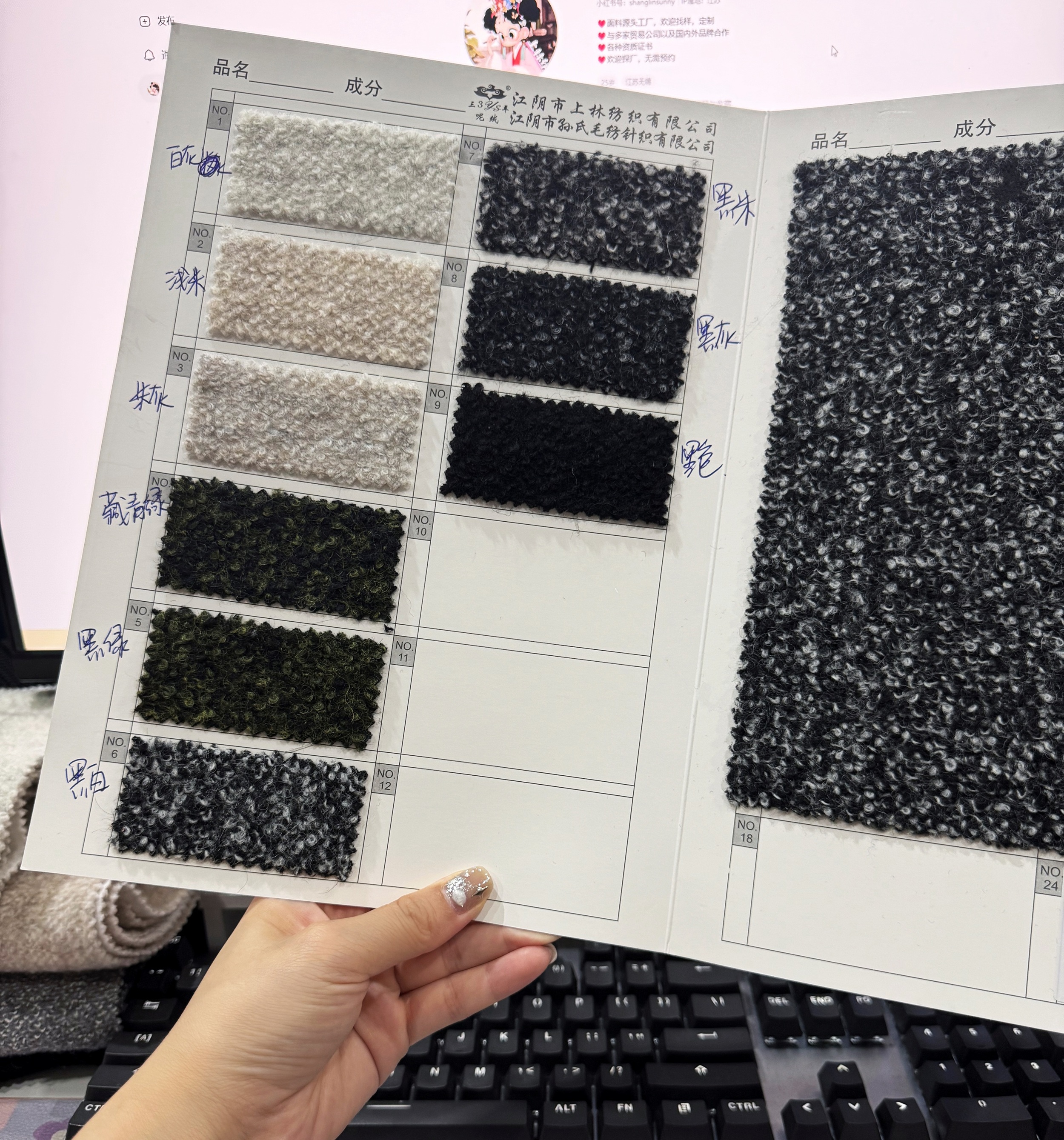
Bouclé and textured fabrics. Complex surface textures are inherently more variable than flat jersey constructions. Quality control for bouclé fabrics includes loop height consistency measurement, visual comparison against approved reference samples, and assessment of surface uniformity across the fabric width. The Shanglin Textile premium knit fabric testing protocol for textured fabrics includes both instrumental measurement and subjective visual evaluation by experienced inspectors.
Continuous Quality Improvement
Quality control is not static — it evolves as new fabric types are developed, new client requirements emerge, and new quality challenges are encountered. Shanglin Textile fabric quality control standards are reviewed and updated regularly based on production experience, client feedback, and industry best practices.
Defect root cause analysis. When quality issues are detected — whether during production or after delivery — Shanglin performs root cause analysis to identify the underlying factor and implement corrective action. This may involve adjusting machine settings, modifying yarn specifications, retraining operators, or upgrading equipment. The goal is not just to fix the immediate problem but to prevent recurrence.
Client feedback integration. Brand clients provide feedback on fabric performance during garment manufacturing — cutting behavior, sewing characteristics, pressing response, and finished garment quality. This feedback is invaluable for identifying quality attributes that may not be captured by standard tests but significantly affect the client's production experience. Shanglin incorporates this feedback into its quality specifications and inspection criteria.