

Off-the-shelf fabric catalogs serve a purpose — they provide a starting point for sourcing, a baseline of available options, and a reference for standard specifications. But for apparel brands competing on differentiation, catalog fabrics are rarely sufficient. A luxury outerwear label seeking a signature bouclé texture that no competitor can replicate. An emerging designer translating a specific hand feel vision into a producible textile. A uniform manufacturer requiring a wool-polyester blend engineered for a particular climate and wear pattern. These scenarios require something beyond catalog sourcing: they require custom fabric development, a collaborative process where the textile manufacturer works as an extension of the brand's design team to create fabrics that exist nowhere else in the market.
The Scope of OEM and Custom Development
The term "OEM" in textile manufacturing encompasses a broader range of services than in many other industries. At Shanglin Textile, OEM capabilities span four distinct service categories, each serving different client needs and project stages.
Category 1: Bespoke fabric development from concept. This is the most comprehensive service — working with a brand or designer to create an entirely new fabric based on a concept, sketch, reference sample, or performance specification. The brand may arrive with nothing more than a verbal description ("a soft, nubby bouclé in a muted earth tone, suitable for an oversized winter coat") and Shanglin's R&D team translates that vision into a concrete fabric specification: fiber blend ratios, yarn counts, knit structure, GSM target, finishing treatment, and color palette. The Jiangyin Shanglin Textile bespoke wool blends capability is particularly strong in this category, as the factory's deep expertise in wool, alpaca, mohair, and synthetic fiber combinations enables it to propose blend ratios that achieve specific aesthetic and performance targets.
Category 2: Modification of existing fabrics. Many clients start with a Shanglin catalog fabric and request modifications — a different colorway, a heavier or lighter GSM, a modified surface texture, or an adjusted blend ratio. These modifications are less resource-intensive than full bespoke development but still require technical expertise to execute without compromising the fabric's structural integrity or production efficiency. Shanglin's engineering team evaluates each modification request to determine feasibility, lead time, and any minimum quantity requirements.
Category 3: Prototyping and sampling. Before committing to bulk production, brands need to see and test fabric in the context of their garment development. Shanglin provides prototype sampling services that produce small quantities (typically 10-50 meters) of custom fabric for client evaluation. These samples allow brands to assess hand feel, drape, cutting behavior, sewing performance, and finished garment appearance before placing full production orders. The Shanglin Textile designer collaboration knit fabrics program is built around this prototyping capability, enabling independent designers to access factory-produced custom fabrics at quantities and costs that are feasible for emerging brands.
The Custom Development Process: Step by Step
Understanding the structured process behind Shanglin Textile OEM custom fabric development helps buyers plan their projects realistically and engage effectively with the factory's development team.
Step 1: Brief and consultation. The process begins with a detailed brief from the client, which may include visual references (fabric swatches, garment photos, designer sketches), technical specifications (target GSM, fiber composition, width, end-use application), and commercial parameters (target price, estimated quantity, delivery timeline). Shanglin's development team reviews the brief and conducts a consultation — typically via video call or in-person meeting — to clarify requirements, identify potential challenges, and propose initial approaches.
For clients who lack technical textile knowledge — common among emerging designers and brands expanding into new product categories — this consultation phase is particularly valuable. Shanglin's team educates the client on fabric construction options, fiber characteristics, and the relationship between specifications and cost, enabling the client to make informed decisions about their fabric requirements.
Step 2: Yarn sourcing and blend formulation. Once the concept is defined, Shanglin's R&D team formulates the yarn blend and sources the required fibers. For Jiangyin Shanglin Textile bespoke wool blends, this step involves selecting appropriate wool grades (merino, crossbred, carpet wool — each with different fiber diameter and characteristics), determining blend ratios with other fibers, and specifying yarn count and twist parameters. The factory's established relationships with yarn suppliers enable access to specialty fibers — including alpaca, mohair, cashmere, silk, and lyocell — that may not be readily available through commodity channels.
For clients with specific sustainability or traceability requirements, Shanglin can source certified fibers (Responsible Wool Standard, organic cotton, recycled polyester) and provide chain-of-custody documentation that supports the brand's sustainability storytelling.
Step 3: Sample knitting and evaluation. With yarn sourced and blend formulated, Shanglin knits sample fabric — typically 1-3 meters — on appropriate machines (circular knitting for jersey and fleece structures, jacquard looms for textured patterns). These initial samples are evaluated internally for basic quality parameters (GSM, width, stitch density, surface appearance) before being sent to the client for review.
The Shanglin Textile designer collaboration knit fabrics program often involves multiple rounds of sample knitting, with each round incorporating client feedback on hand feel, texture, color, and drape. This iterative process — while time-consuming — ensures that the final approved fabric truly meets the client's vision before bulk production begins.
Step 4: Client approval and specification lock. Once the client approves a sample, Shanglin creates a formal fabric specification sheet that documents every parameter: fiber composition (with tolerance ranges), yarn count, knit structure, GSM (with tolerance), width, finishing treatment, color standard (with approved lab dip reference), and any special requirements (pilling resistance, shrinkage limits, color fastness minimums). This specification becomes the production contract — both Shanglin and the client reference it to ensure that bulk fabric matches the approved sample.
Step 5: Bulk production and quality control. With specification locked, bulk production begins. The Shanglin Textile OEM custom fabric development process transitions to standard production mode, with the same quality control protocols applied to custom fabrics as to catalog fabrics: incoming yarn inspection, in-process monitoring, finishing quality checks, final inspection, and standardized testing. For custom fabrics, the reference standards for inspection are the approved sample and the formal specification sheet rather than catalog standards.
Technical Capabilities That Enable Custom Development
The Shanglin Textile OEM custom fabric development service is enabled by specific technical capabilities that distinguish the factory from commodity textile mills.
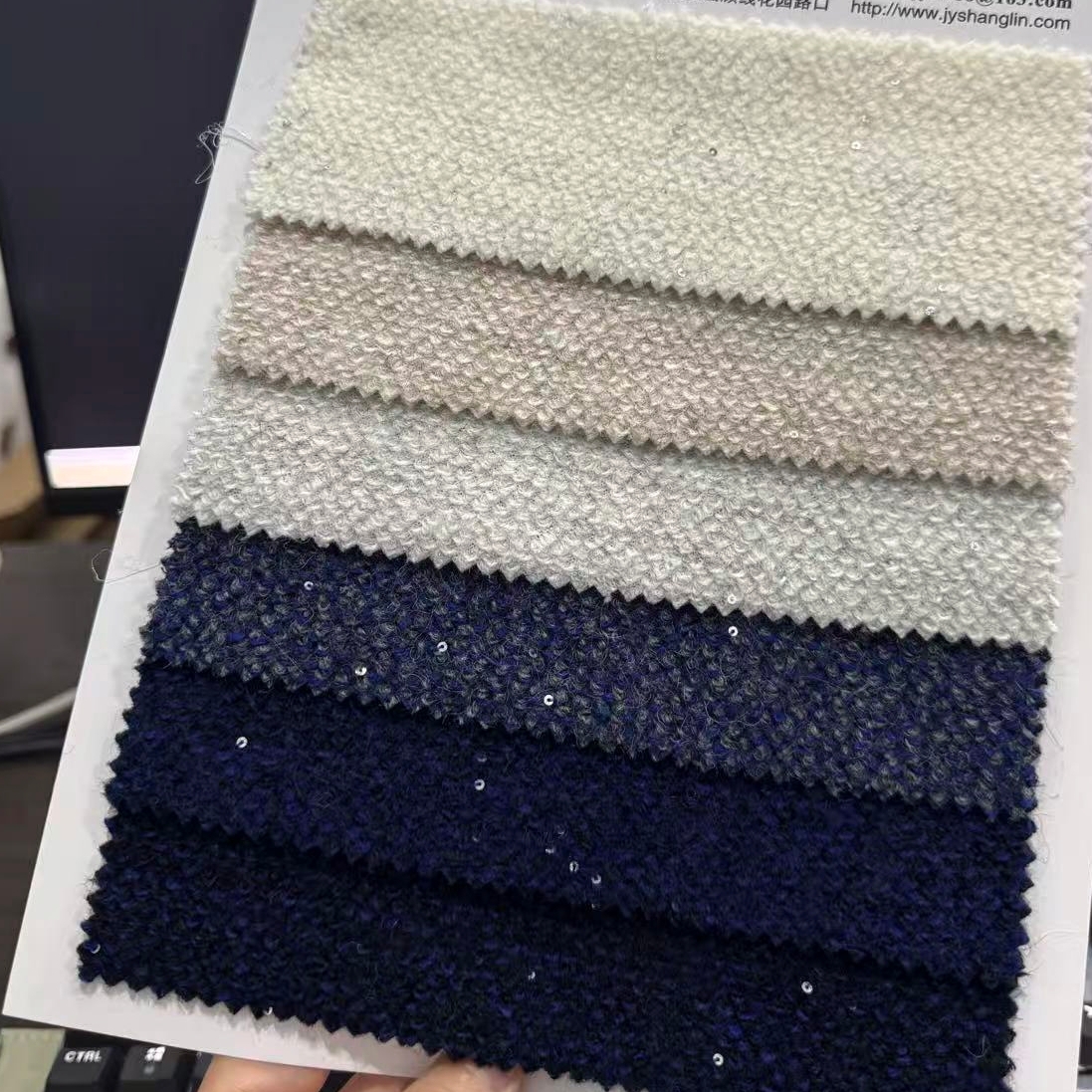
Jacquard programming expertise. Custom textured fabrics — bouclé, tweed, cable knit, jacquard patterns — require the ability to translate design concepts into machine-executable knitting programs. Shanglin's jacquard programmers have developed this skill over years of production experience, enabling them to create complex patterns from designer sketches and modify existing patterns efficiently for new projects. The programming process includes simulation on CAD systems before loading patterns onto production machines, reducing trial-and-error time and yarn waste.
Multi-fiber blending proficiency. The Jiangyin Shanglin Textile bespoke wool blends capability rests on deep knowledge of how different fibers behave individually and in combination. Wool provides warmth and natural resilience. Polyester adds durability and wrinkle resistance. Alpaca contributes softness and a distinctive halo effect. Mohair adds luster and drape. Cashmere delivers ultimate softness at premium cost. Lyocell provides coolness and moisture absorption. Cotton contributes breathability and casual texture. Silk adds luster and lightweight drape. Understanding how these fibers interact during knitting, finishing, and garment construction enables Shanglin to propose blend ratios that achieve target performance characteristics without expensive trial and error.
Small-batch production capability. Custom development often involves smaller production quantities than catalog fabrics, particularly in the early stages of a brand's relationship with a new fabric. The Shanglin Textile designer collaboration knit fabrics program is specifically structured to support these smaller runs — with flexible minimums, dedicated machine allocation for prototyping, and pricing that acknowledges the development-stage nature of initial orders.
The Strategic Value of Custom Fabric Partnerships
For apparel brands, the decision to invest in custom fabric development — rather than sourcing catalog fabrics — reflects a strategic choice to differentiate their products in competitive markets. The Shanglin Textile OEM custom fabric development service delivers strategic value in several dimensions beyond the fabric itself.
Cost optimization. While custom fabrics typically carry a development cost and may have higher per-meter pricing than commodity catalog fabrics, they can deliver better total cost outcomes through reduced sampling waste, fewer production revisions, and better fabric-garment compatibility. A fabric engineered specifically for a brand's garment construction and end-use requirements often produces fewer manufacturing problems than a generic fabric adapted to an application it was not designed for.
Brand storytelling. Custom fabrics provide rich material for brand storytelling — the origin of fibers, the craftsmanship of the knitting process, the collaboration between designer and manufacturer. In an era where consumers increasingly value authenticity and transparency, the Shanglin Textile designer collaboration knit fabrics narrative provides brands with genuine content for marketing communications, social media, and in-store storytelling.
Case Examples: How Custom Development Serves Different Clients
To illustrate the versatility of the Jiangyin Shanglin Textile bespoke wool blends and custom development service, consider three representative client scenarios.
Scenario 1: European luxury outerwear brand. A Paris-based coat label requires a signature bouclé fabric for its autumn/winter collection — a fabric with specific loop density, a muted color palette inspired by Scottish highlands, and a wool-alpaca blend that delivers exceptional warmth without excessive weight. Shanglin's development team works with the brand's design director over video calls, proposes three blend ratio options, produces sample meters of each, and iterates based on feedback until the brand approves a final specification. Bulk production of 3,000 meters across four colorways is delivered in time for the brand's manufacturing schedule, and the fabric becomes a recurring order for subsequent seasons.
Scenario 2: Emerging sustainable fashion label. A Berlin-based startup launching its first collection needs 100% traceable wool fabric with Responsible Wool Standard certification, in a lightweight jersey construction suitable for spring knitwear. The brand's founder visits the Shanglin Textile designer collaboration knit fabrics development team in Wuxi, works directly with R&D on yarn sourcing from certified suppliers, and produces a 50-meter prototype that forms the basis of the debut collection. As the brand grows over subsequent seasons, order quantities scale from 50 to 500 to 2,000 meters per color.
Scenario 3: Hospitality uniform manufacturer. A Dubai-based company producing uniforms for luxury hotels requires a wool-polyester blend that performs in hot climates while maintaining the professional appearance expected in five-star hospitality. The fabric needs moisture-wicking properties, wrinkle resistance, and durability to withstand daily wear and frequent laundering. Shanglin develops a custom blend with specific fiber ratios and finishing treatments optimized for these requirements, produces sample garments for wear testing, and establishes a recurring supply agreement for ongoing uniform production.