

The men's suit market is undergoing a quiet revolution. For decades, woven wool fabrics dominated suiting — structured, formal, and traditionally constructed. But contemporary menswear is shifting toward comfort, versatility, and performance. Knit suit fabrics are emerging as a compelling alternative, offering the tailored appearance of traditional suiting with the comfort and stretch of knit construction. For brands targeting modern professionals, travelers, and style-conscious consumers who refuse to sacrifice comfort for appearance, knit suiting represents a significant market opportunity.
Why Knit Suiting is Gaining Market Share
Understanding the market drivers behind knit suiting's growth helps buyers assess whether this fabric category aligns with their brand positioning and target customer.
Comfort revolution. Modern professionals spend long hours in suits — commuting, working at desks, attending meetings, traveling. Traditional woven suiting restricts movement and can feel constricting after extended wear. Knit fabrics offer inherent stretch and recovery, allowing freedom of movement while maintaining a tailored silhouette. This comfort advantage is particularly valued by younger professionals entering the suit market for the first time.
Work-from-home transition. The shift to remote and hybrid work has reduced daily suit-wearing occasions, but increased demand for versatile garments that transition from home to office to social events. Knit suits offer the polished appearance required for professional settings with the comfort suitable for home environments — a versatility that traditional suiting cannot match.
Travel performance. Business travelers value wrinkle resistance, comfort during long flights, and garments that perform across time zones and climates. Knit suiting's inherent wrinkle recovery and stretch make it superior to woven fabrics for travel applications.
Athleisure influence. The athleisure trend has conditioned consumers to expect comfort and performance from all garments, including formal wear. Knit suiting bridges the gap between tailored aesthetics and casual comfort, appealing to consumers who have embraced performance fabrics in other categories.
Shanglin's Suit Fabric Range
Shanglin Textile produces two primary fabric categories suitable for men's suiting applications, each with distinct properties for different suit constructions and market positions.
Wool-Polyester Fleece Tweed (370 GSM, 40% Wool / 60% Polyester)
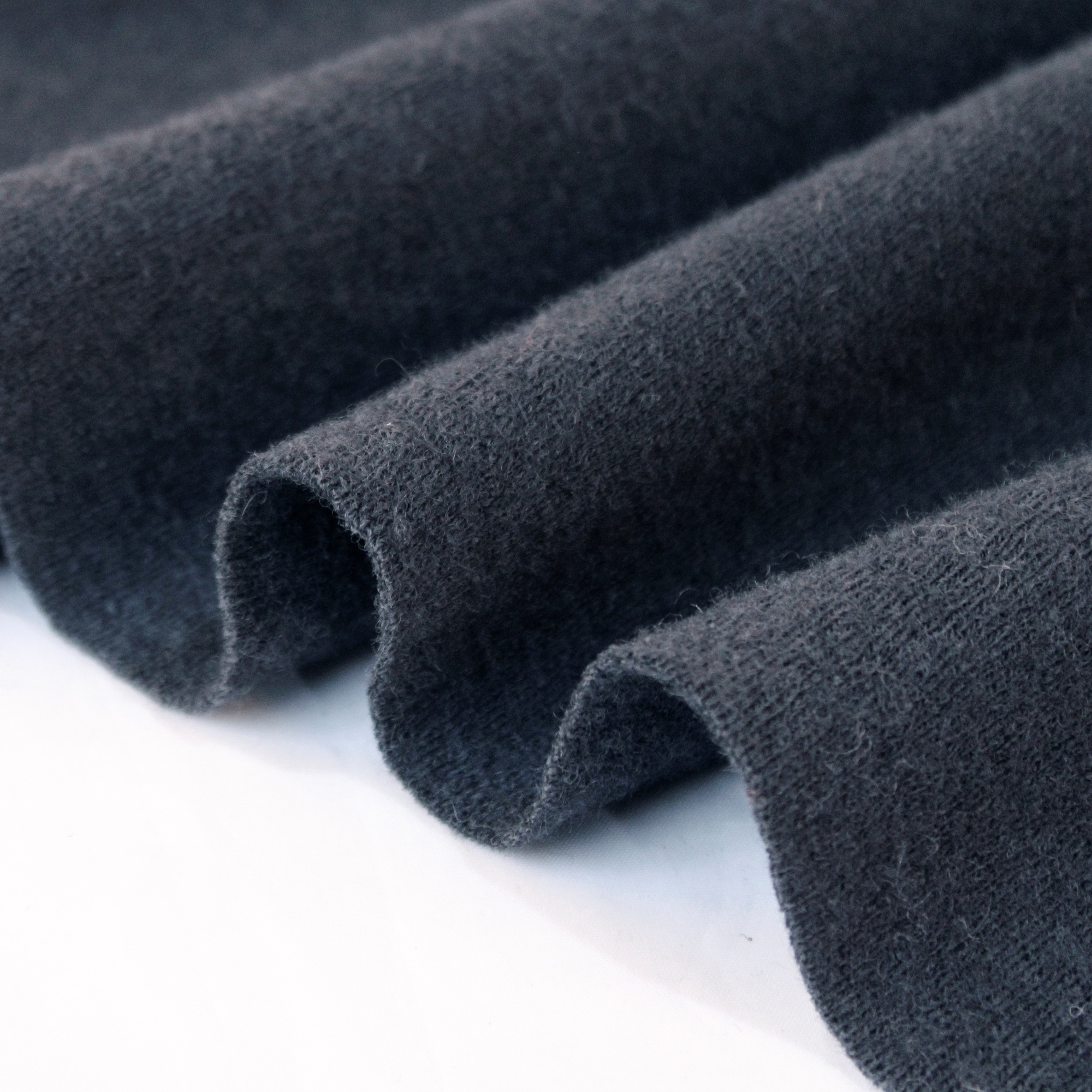
Construction and properties. This fabric combines the visual aesthetic of traditional tweed — flecks of contrasting color, a slightly napped surface — with knit construction that provides stretch and comfort. At 370 GSM, it offers substantial body and structure suitable for suit jackets and trousers. The 60% polyester content improves durability, wrinkle resistance, and cost efficiency compared to pure wool.
Technical specifications.
- Weight: 370 GSM (heavy-weight for suiting)
- Composition: 40% wool / 60% polyester
- Width: 145-150 cm
- Stretch: 15-20% crosswise recovery
- Shrinkage: 3-5% (washed 3 cycles at 40°C)
- Wrinkle recovery: Excellent (polyester content)
- Pilling resistance: Good (grade 4 on 5-point scale)
- Color fastness: Grade 4-5 (washing), Grade 4 (light), Grade 4 (rubbing)
Advantages for suiting.
- Traditional tweed aesthetic appeals to classic menswear markets
- Knit stretch provides comfort for extended wear
- Polyester content improves wrinkle resistance and durability
- Machine washable (gentle cycle) for easy care
- Cost-effective compared to pure wool suiting
- Substantial body maintains jacket structure without excessive interfacing
Limitations.
- Heavier weight may be warm for summer or tropical climates
- Traditional aesthetic may not suit ultra-modern fashion markets
- Less breathable than pure wool due to polyester content
Best applications. Sport coats, casual blazers, unstructured suit jackets, travel suits, and workwear-inspired tailoring. The wool polyester suiting textile sourcing market values this fabric for brands targeting practical, comfort-focused menswear.
Double-Sided Wool Knit (350-380 GSM, Wool-Polyester Blends)
Construction and properties. Double-sided knit fabrics have two distinct face sides — often different colors or textures — connected by interlocking yarns. These reversible fabrics offer versatility and eliminate the need for lining. For suiting applications, double-sided knits provide clean finishes on both interior and exterior surfaces.
Technical specifications.
- Weight: 350-380 GSM
- Composition: Varies (typically 40-60% wool, balance polyester)
- Width: 145-150 cm
- Stretch: 20-25% crosswise recovery
- Shrinkage: 3-5% (washed 3 cycles at 40°C)
- Wrinkle recovery: Excellent
- Reversible: Two distinct face sides
Advantages for suiting.
- Reversible design offers two garments in one (e.g., navy/charcoal)
- Eliminates lining requirement, reducing cost and weight
- Clean finish on both sides enhances garment quality perception
- Versatile styling options for consumers
- Excellent drape and comfort

Limitations.
- Limited to unlined or partially lined constructions
- Heavier than single-layer suiting fabrics
- More complex garment manufacturing required
Best applications. Reversible jackets, unlined blazers, travel suits, and contemporary suiting where versatility is valued. The Shanglin Textile suit fabric men's suiting range includes double-sided options for brands seeking this functional advantage.
Knit Suiting vs Woven Suiting: Technical Comparison
The knit suit fabric technical guide China expertise includes understanding how knit suiting compares to traditional woven alternatives across key performance dimensions.
Stretch and comfort.
- Knit: 15-25% crosswise stretch with excellent recovery; allows freedom of movement
- Woven: Minimal inherent stretch (unless elastane is added); restricts movement
Wrinkle resistance.
- Knit: Excellent wrinkle recovery due to loop structure; garments can be packed and worn with minimal pressing
- Woven: Moderate to poor wrinkle recovery; requires pressing after packing or extended wear
Drape.
- Knit: Softer drape that follows body contours; suitable for unstructured and soft-tailored constructions
- Woven: Crisper drape with more body; suitable for structured, traditional tailoring
Breathability.
- Knit: Loop structure allows air circulation; comfortable across temperature ranges
- Woven: Tighter construction reduces air circulation; can feel warmer in equivalent weight
Durability.
- Knit: Good durability but may pill with friction; requires appropriate care
- Woven: Excellent durability and abrasion resistance; withstands heavy wear
Formality.
- Knit: Contemporary, casual-to-business-casual aesthetic; less formal than traditional suiting
- Woven: Classic, formal appearance; appropriate for conservative business environments
Cost.
- Knit: Moderate pricing; wool-polyester blends offer cost efficiency
- Woven: Wide range from commodity to luxury; pure wool woven suiting is typically more expensive than knit alternatives

Suit Construction Considerations for Knit Fabrics
The wool polyester suiting textile sourcing expertise includes guidance on garment construction techniques specific to knit suiting fabrics.
Pattern adjustments. Knit fabrics require different pattern blocks than woven suiting. Patterns should accommodate the fabric's stretch — reducing ease allowances, adjusting dart placement, and modifying seam allowances. Garment manufacturers experienced in woven suiting may need to adapt their pattern-making approach for knit fabrics.
Interfacing requirements. Knit suiting fabrics have less inherent body than woven alternatives, particularly at lighter weights. Fusible interfacing at collars, lapels, chest pieces, and cuffs provides structure and shape retention. The interfacing should be compatible with knit stretch — using stretch interfacings that move with the fabric rather than restricting it.
Seam construction. Knit fabrics require stretch stitches (zigzag, overlock, or coverstitch) rather than straight stitches used in woven suiting. Seam allowances should be finished to prevent curling and fraying. Topstitching may be minimized to preserve the fabric's clean aesthetic.
Lining considerations. Single-layer knit suiting may require partial lining for comfort and clean interior finish. Half-lining (lining only the upper back and sleeves) reduces weight and cost while providing structure where needed. Double-sided knit fabrics eliminate lining requirements entirely.
Hardware and closures. Knit fabrics must support buttons, buttonholes, and pocket construction without distortion. Reinforcement at stress points (button attachment, pocket corners) prevents fabric damage and ensures durability.
Market Positioning for Knit Suits
The Shanglin Textile suit fabric men's suiting range serves several growing market segments:
Business casual and contemporary suiting. Brands targeting modern professionals who want polished appearance without traditional formality. Knit suits offer versatility for office, client meetings, and after-work social events.
Travel and performance suiting. Brands emphasizing wrinkle resistance, comfort during travel, and easy care. Knit suits can be packed, worn immediately, and maintain appearance without pressing.
Athleisure-influenced tailoring. Brands bridging the gap between casual wear and formal suiting, targeting consumers who expect comfort and performance from all garments.
Sustainable and ethical fashion. Brands positioning on reduced waste, recycled content (recycled polyester in blends), and versatile garments that reduce overconsumption.
Young professionals and first-time suit buyers. Consumers entering the suit market who prioritize comfort and contemporary aesthetics over traditional formality.
Color and Design Considerations
Knit suiting fabrics must balance versatility with style. The knit suit fabric technical guide China expertise includes color recommendations for different market segments.
Classic neutrals. Navy, charcoal, medium gray, and black serve conservative markets and consumers seeking versatile, long-lasting garments. These colors work across business and social contexts.
Contemporary neutrals. Olive, burgundy, taupe, and slate blue provide modern appeal while maintaining versatility. These colors differentiate from traditional suiting without appearing trendy.
Textured patterns. Fleece tweed's characteristic flecked pattern adds visual interest while remaining subtle and versatile. The texture reads as sophisticated rather than casual.
Seasonal variations. Lighter weights (300-350 GSM) in lighter colors (light gray, tan, olive) serve spring/summer markets. Heavier weights (370+ GSM) in darker colors serve autumn/winter collections.
Care and Maintenance
Knit suiting fabrics offer care advantages over traditional woven suiting:
Machine washing. Wool-polyester blends can typically be machine washed on gentle cycles with cool water (30°C maximum) and wool-specific detergent. This contrasts with traditional wool suiting, which typically requires dry cleaning.
Drying. Line dry or tumble dry on low heat. Avoid high heat, which can damage wool fibers and cause shrinkage.
Pressing. Knit suits require minimal pressing due to excellent wrinkle recovery. Light steam pressing refreshes the garment between wears. Avoid heavy pressing, which can flatten the knit structure.
Storage. Hang on shaped hangers to maintain jacket structure. Knit suits resist wrinkling during storage and travel.
The wool polyester suiting textile sourcing market values these care advantages as selling points for practical, low-maintenance garments.